
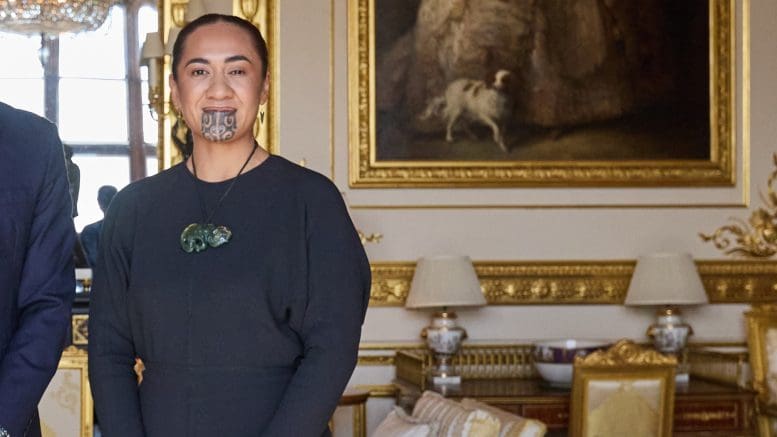
King Charles III met with the Māori Queen this week.
King Charles III received Queen Nga Wai Hono i te Po yesterday at Buckingham Palace. The audience marked a significant moment in the relationship between the two as Aotearoa New Zealand approaches the 200-year anniversary of the signing of Te Tiriti o Waitangi in 2040. The meeting was also the first time the monarchs had met since each other’s respective accessions.
Her Majesty Nga Wai Hono i te Po (29) is the Kuini [Queen] of the Māori people, the indigenous people of Aotearoa New Zealand. The populace is descended from settlers who arrived on the island more than 800 years ago in “great waka” (double-hulled canoes) from eastern Polynesia. While many of their traditions incorporate Polynesian culture, their time as an isolated community before European settlement fostered their own distinctive crafts, language, mythology, and way of life. The Māori were organised in iwi [tribes], each of which comprised several hapū [clans] that occupied specific territory.
In 1856, on the shores of Lake Taupō at Pūkawa, the Waikato Chief Pootatau Te Wherowhero was nominated as the first Māori monarch. Following his nomination, the Kiingitanga [Māori King movement] was established in 1858, which united all the iwi [tribes] under King Pootatau Te Wherowhero — being installed at Ngāruawāhia — with the goal of ending the sale of land to non-Indigenous people, stopping inter-tribal warfare, and providing a springboard for the preservation of Māori culture. While he attended church services, Te Wherowhero was never baptised. King Te Wherowhero didn’t see his role as being in direct opposition to the sovereignty of Queen Victoria; it is believed he instead wished to work together with the British Crown. King Te Wherowhero died in 1860, with his son, Tāwhiao, becoming the next monarch.
There have been a total of eight Māori sovereigns, starting with King Te Wherowhero — six kings and two queens. One of the most popular and well-known was the current Queen’s grandmother, Queen Te Atairangikaahu, who reigned from 1966 to 2006. The late Queen represented Māori both at home and around the world. Queen Te Atairangikaahu hosted foreign royalty, heads of state, government leaders, diplomats, ambassadors and religious leaders. She also travelled extensively to the communities each year, offering the population the opportunity to see the Queen in person. She was also received by Pope Paul VI in the Vatican. Te Atairangikaahu was made a Dame Commander of the British Empire in the 1970’s New Year’s Honours List for “outstanding services to the Māori people.”
After an illness, Queen Te Atairangikaahu died in August 2006, which plunged the Māori populace into a weeks-long mourning. While the throne is passed from parent to child, the Māori monarchy does not follow primogeniture and is elective. The late Queen’s son was chosen as her successor — Te Wherowhero VII. The late King was also very popular for his efforts to unify Māoridom. Te Wherowhero VII suffered from ill health most of his life and, after cardiac surgery in Hamilton, NZ, the late King died on 30 August, 2024 at Waikato Hospital, aged 69, just days after the 18th anniversary of his accession.
The passing of Te Wherowhero VII left many wondering, both within and outside the Kiingitanga, who would succeed the late monarch? Since the throne is not hereditary, it was left to a council of elders and experts, known as Tekau mā rua, during a wānanga to appoint the next monarch. It was decided that the late King’s 27-year-old daughter and youngest child would become the second Māori Queen.
Nga Wai Hono i te Po was born in January 1997, is fluent in the Māori language and has a true passion for Māori culture. Her father ascended to the Throne when she was just nine years old. As a Princess, Nga attended the University of Waikato, graduating in 2017 with a Bachelor of Arts in Tikanga Māori, and later pursued a Master’s degree in 2020. She was also a kapa haka teacher, the Māori traditional performing arts.
She began taking on duties as a member of the royal family by attending various cultural functions, which increased her prominence both at home and abroad. She travelled to the United Kingdom in June 2022, meeting with then-Prince Charles, following in the footsteps of her ancestors, including King Tawhiao, who ‘travelled to England in the 1880s seeking an audience with Queen Victoria over concerns Te Tiriti o Waitangi was not being honoured.’
She was consecrated with a Bible during the tangihanga (funeral) of her father by Archbishop Donald Steven Tamihere. As Queen, the role is largely ceremonial; she is also considered the paramount chief of the iwi. Many admire her devotion to Māori culture and openness to others. She is known to have a “quick wit”, “deep sense of intellect”, and a true sense of humour.
Today The King received Māori Queen Te Arikinui Nga wai hono i te po at Buckingham Palace. pic.twitter.com/NroHu8Q81o
— The Royal Family (@RoyalFamily) May 14, 2026
In May 2026, the Kiingitanga announced that the Queen would be visiting the United Kingdom for the first time since her accession to mark the 50th anniversary of The King’s Trust, previously The Prince’s Trust. Four rangatahi [young Māori] entrepreneurs from Aotearoa took part in the celebrations at the Royal Albert Hall this past Monday with the Queen. The rangatahi have established businesses that are creating jobs and opportunities for whānau and their local communities.
Yesterday afternoon, in a historic meeting for both, King Charles received Queen Nga Wai Hono i te Po at Buckingham Palace ahead of the Garden Party celebrating The Trust. The garden party brought together over 4,000 beneficiaries, volunteers, staff and supporters to the Palace.
The Queen is now 29 years old, remains unmarried and has reigned for over a year and eight months.




Be the first to comment on "King Charles receives Māori Queen"