
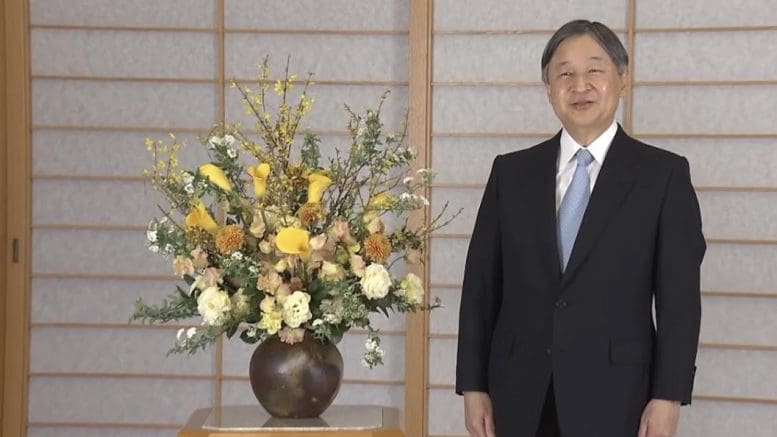
Emperor Naruhito of Japan attended a press conference in connection with his 66th birthday this week.
Prince Naruhito was born on 23rd February 1960, to Crown Prince Akihito and Crown Princess Michiko at the IHA Hospital of the Imperial Palace in Tokyo. At the time, Naruhito was second in the line of succession to the Chrysanthemum throne. The Prince studied at Gakushūin and Oxford Universities, respectively. Later, as Crown Prince, Naruhito married Masako Owada in June 1993. The Crown Prince Couple had one child together, a daughter named Princess Aiko, in 2001.
Naruhito’s father, Emperor Akihito, announced his abdication in 2017, being succeeded in May 2019. Emperor Naruhito and Empress Masako held a traditional Enthronement ceremony attended by the world’s royal families and distinguished guests.
The 126th Emperor has reigned for almost seven years now, and is characterised by the harmony and stability in modern Japan.
February 2026 sees Emperor Naruhito celebrate his 66th birthday. As is tradition, the Emperor gave a press conference to journalists about the year past and looking to the future.
The Royal News Organisation takes a look at some of the questions presented to the Emperor in the Shakkyo-no-Ma (Drawing Room) of the Imperial Palace.
Question: Last year marked the 80th anniversary of the end of the war, and you visited various places to pay your respects to the war dead, with Princess Aiko accompanying you. Please tell us about an event that made a lasting impression on you over the past year.
Emperor Naruhito: Together with Aiko, the three of us visited Okinawa Prefecture, Nagasaki Prefecture, the Tokyo Memorial Hall, and the Showakan Museum. We are deeply saddened by the loss of so many precious lives in countries around the world during the last war. This time, we visited various parts of Japan and once again offered our deepest condolences to those who lost their lives. In each place, we spoke with those who suffered from the war damage, the surviving families of those who died, and those working to pass on the memories of the war. Each and every memory that you shared with us remains deeply etched in our hearts. (…)
It was also a source of great joy and a lasting memory that Osaka University Professor Shimon Sakaguchi and Kyoto University Professor Susumu Kitagawa, who have both tirelessly pursued their research and made great efforts over many years, were awarded the Nobel Prize in Physiology or Medicine and the Nobel Prize in Chemistry, respectively.
In terms of sport, I was also delighted to be able to attend the World Athletics Championships in September and the swimming events at the Deaflympics in November. It was my first time watching a Deaflympics event, and what was particularly striking was the sense of unity in the venue, as the spectators cheered on the athletes with “signal cheers” that didn’t rely on sounds like applause or cheers, in addition to the athletes’ hard work.
I’m also watching the exciting competition at the Milan-Cortina 2026 Winter Olympics, currently being held in Italy, on television. I sometimes watch with Masako and Aiko, and I’m very happy to see the success of Japanese athletes. I’m deeply impressed by the athletes’ determination to give their all in the competitions, their words of gratitude to their families, supporters, and cheering fans, and their mutual recognition and praise across borders and regions. The athletes’ success gives us strength and courage, and I express my heartfelt respect for the efforts of each and every athlete.
Question: With the number of Imperial Family members declining, Prince Akishino expressed his view at a press conference last year that “there may be no choice but to reduce the scale of our overall public activities.” What are Your Majesty’s thoughts on the overall activities of the Imperial Family, its role, and the “new official duties in line with the times” that you have mentioned so often?
Emperor Naruhito: I believe that the foundation of the Imperial Family’s role and activities is to always wish for the happiness of the people and share their joys and sorrows. I also believe that it is important to fulfil our duties in accordance with the circumstances, taking into account the changing times and changes in society.
In these circumstances, it seems increasingly important to show consideration for those in difficult situations and those in positions that require social consideration. I believe that it is our important duty to listen to the voices of those facing various challenges, such as those affected by disasters, people with disabilities, the elderly, and children in difficult circumstances, and to wish them happiness.
The world is undergoing major changes in many areas, including a declining birthrate and ageing population, climate change, the increasing severity and frequency of disasters, the growing risk of infectious disease spreading as seen in the COVID-19 pandemic, and the development of new science and technology, such as AI. I believe it is important to understand the current state of the world while also taking into account its history, and to strive to grasp what the future holds, while accurately sensing the trends of the times and considering how public service should be conducted in a way that is appropriate for each era.
Question: The Emperor Emeritus [Akihito] was hospitalised twice last year. Please tell us about the couple’s reaction to their health and their recent condition.
Emperor Naruhito: I would like to express my gratitude to Their Majesties the Emperor and Empress Emerita for their continued warmth in watching over us. Last year, during the 80th anniversary of the end of the war, I made repeated visits to various places and was reminded once again of how seriously Their Majesties have taken the war and how they have devoted themselves to cherishing peace above all else.
We were concerned about His Majesty the Emperor Emeritus when he was hospitalised in July last year for treatment for asymptomatic myocardial ischemia, but we have heard that he has been in relatively stable condition since then.
I was pleased to be able to meet Their Majesties together on His Majesty the Emperor Emeritus’ birthday in December last year, Masako’s birthday, and again this New Year, and to see that they are in good health. I once again feel deep respect for the duties that Their Majesties the Emperor Emeritus and Empress Emerita have performed over the years, and I sincerely hope that they will continue to take good care of their health and live long, healthy lives.
Question: The Empress [Masako] has been engaged in a variety of official duties over the past year. Please tell us about her recent activities and health.
Emperor Naruhito: Over the past year, Masako has been able to perform many official duties, including several visits to Tokyo and the countryside to mark the 80th anniversary of the end of World War II; two visits to the 2025 World Expo in Japan (Osaka-Kansai Expo); interactions with the Brazilian President and First Lady, who visited Japan as State Guests for the first time in six years, as well as many dignitaries who visited Japan for the Osaka-Kansai Expo and the 9th Tokyo International Conference on African Development; and a state visit to Mongolia.
Both Masako and I are grateful for the warm support we have received from so many people. Masako strives to stay in good health for each official duty and prepares wholeheartedly for each one. However, as she is still recovering, her health fluctuates, and she may feel fatigued for some time after a major event or a series of events. At such times, I urge her to get plenty of rest and to continue to steadily accumulate what she can do, one task at a time, without overexerting herself. I myself am deeply grateful for the support Masako has given me both in my daily life and in my official duties. Furthermore, we both cherish opportunities to interact with the people of Japan, while keeping in mind the various situations and difficulties they face.
I personally feel that meeting various people together with Masako deepens our conversations and allows me to gain various insights. I also make an effort to regularly take an interest in the situations in countries around the world and various global issues. Masako and I hope to continue to wish for the happiness of the people of Japan and to work together to fulfil our duties.
Question: Princess Aiko made her first official overseas visit to Laos, expanding the scope of her activities. Please tell us about Princess Aiko’s activities, time spent with the family, and how His Majesty spends his private time, including some anecdotes.
Emperor Naruhito: It’s been almost two years since Aiko started working at the Japanese Red Cross Society, and she’s approaching her third year as a working professional. She continues to receive warm guidance from those around her, and it seems she’s gradually becoming accustomed to her new job. I’m delighted to see her working hard and working together with everyone, demonstrating her steady growth as a working professional. Having no prior experience working in the real world, each story Aiko shares is fresh and fascinating, almost like an “uncharted journey.” In her daily work, she has also developed an interest in volunteer activities and disaster prevention. Last year, she visited areas affected by the Noto Peninsula earthquake and Niigata Prefecture to attend the National Conference on Disaster Prevention Promotion. I hope she continues to broaden her horizons and grow even more through her many experiences.
Last November, she also visited Laos on her first official overseas visit, where she was warmly welcomed by President Thongloun, government officials, and the Laotian people. We are delighted that Aiko, with her interest in Laotian history and culture, prepared for the occasion and performed her duties wholeheartedly. After returning to Japan, she shared with us her various experiences and the people she met in Laos.
I believe that the scope of her work as a member of the Imperial Family will gradually expand in the future. I hope that Aiko will continue to be grateful and considerate, continue to gain more experience, grow even more, and cherish her duties as a member of the Imperial Family. We are blessed to be able to spend each day feeling gratitude for each other and the strong bond of our family. Spending time with Aiko not only makes our lives more peaceful and enjoyable, but I also feel that each and every experience Aiko has in her daily life leads to new learning for us as her parents.
Our family all loves nature, and Masako and Aiko especially love living things. We currently have two adorable cats, and we are grateful to be able to spend an enjoyable time with them during our retreats in Susaki and Nasu. Every early summer, Aiko and I enjoy working with Masako on sericulture. Recently, the three of us often watched the Milan-Cortina 2026 Winter Olympics on television. I am truly grateful to everyone for the warm support you have shown Masako and Aiko thus far. I hope you will continue to support us in this way.
In my free time, I usually enjoy jogging within the Imperial Palace grounds or taking walks with Masako, exercising to stay healthy while taking in the changing seasons. During our walks, I enjoy interacting with the horses and police dogs in the stables within the palace grounds, and recently I have been enjoying the seasonal plum blossoms. I also continue to practice the viola and violin, little by little. Last year, during my visit to Mongolia in July, I had the opportunity to play the viola with the Mongolian National Morin Khuur Symphony Orchestra, which was a wonderful memory for me. I always feel that music, including the viola, provides healing and strength.
Water issues have many facets, from safe drinking water and sanitation to water transportation, and even climate change and water-related natural disasters, all of which are deeply connected to people’s lives and global challenges. Addressing water issues requires not only scientific knowledge, but also individual effort and cooperation between people and between countries. (…)
Question: This year marks 15 years since the Great East Japan Earthquake and 10 years since the Kumamoto Earthquake. Please tell us your thoughts on reconstruction and what role you would like to play as a symbol in this era of continuing disasters.
Emperor Naruhito: This year marks 15 years since the Great East Japan Earthquake and 10 years since the Kumamoto Earthquake. It pains me to recall the devastating damage the disaster caused across the nation. In the affected areas, progress has been made toward reconstruction thanks to the tireless efforts of many people.
I would like to express my deep respect for your efforts so far, and once again express my gratitude to the many people who have supported the reconstruction efforts, including the support and cooperation from overseas. In the affected areas, while reconstruction has progressed in terms of infrastructure, I feel that there are still challenges, such as rebuilding livelihoods and communities. Furthermore, when I think of those who have lost loved ones or whose living environment has been completely changed, I feel that the wounds of the disaster have not yet healed. The impact of disasters varies from person to person, and I believe that the impact is significant and cannot be measured simply by the passage of 10 or 15 years. Together with Masako, I will continue to extend my heartfelt support to the disaster-stricken areas.
I have heard that in the disaster-stricken areas, efforts are being made by the younger generation to pass on the experiences and lessons of the disaster. I am encouraged to see this initiative also underway in Hyogo Prefecture, which marked the 30th anniversary of the Great Hanshin-Awaji Earthquake, which I visited last year. There is a modern aphorism that goes, “Natural disasters strike when we least expect them.” I strongly believe that it is necessary to pass on the experiences and lessons of large-scale disasters across generations, keep in mind the experiences of recovery and reconstruction, and once again reaffirm our preparations for future Nankai Trough earthquakes and earthquakes directly beneath the capital.
Aiko also visited the areas affected by the Noto Peninsula earthquake last year and attended disaster prevention events. During this time, she experienced firsthand the enormous impact that disasters have on the people in the disaster-stricken areas and the long time and effort that recovery requires. I believe she also deeply values the importance of passing on the memories of disasters and reconstruction for future generations. I hope Aiko will continue to show her sympathy for the people in the disaster-stricken areas.
Throughout Japan’s history, there have been many difficult times marked by successive major natural disasters. During those times, successive Emperors did various things. Emperor Shōmu of the Nara period, when epidemics and natural disasters continued, strongly desired to calm the unstable world and erected the Great Buddha. During the following Heian period, Emperor Saga is said to have copied the Heart Sutra (Hannya Shingyo) in the hope of ending epidemics. This practice continued into the Kamakura period and beyond, with Emperors Go-Kōgon, Go-Hanazono, Gonara, Ōgimachi, and Emperor Kōkaku of the Edo period all copying the Heart Sutra (Hannya Shingyo) with similar feelings. I viewed the Heart Sutra copied by these six Emperors at Daikaku-ji Temple in Kyoto, and was deeply moved by the aspirations of each successive Emperor, who earnestly prayed for peace in the country and the well-being of its people. Emperor Kōkaku is also said to have requested the shogunate to release rice for the people suffering during the unprecedented Tenmei famine.
I believe that each successive Emperor has inherited this aspiration to sympathise with the suffering of the people in each era, and has endeavoured to do what they could at each time. Their Majesties the Emperor Emeritus and Empress Emerita have visited the affected areas and visited the victims of major disasters, including the Unzen-Fugen volcano eruption, the Great Hanshin-Awaji Earthquake, the Great East Japan Earthquake, and the Kumamoto Earthquake. I, too, while reflecting on the path walked by successive Emperors, would like to always hope that disasters will not occur in this era in which natural disasters have become more severe and frequent in recent years, share the joys and sorrows of the people, listen to the voices of those in the disaster-stricken areas, and stand by the people.
Question: I would like to ask about the current Imperial Family. What do you think of Prince Hisahito, who has begun his activities as an adult member of the Imperial Family?
Emperor Naruhito: Prince Hisahito successfully completed the various ceremonies for his Coming-of-Age Ceremony last year. I am pleased to see how well he has grown. I have watched him grow as a nephew since he was little, and I am pleased to see him fulfilling his duties as a member of the Imperial Family, visiting Tokyo and the countryside and interacting with people from other countries.
I hope that Prince Hisahito will have a fruitful student life, meeting many different people throughout his university years and focusing on his future. From my own experience, I believe that the various experiences, including academics, that one has during their university years are extremely useful in life afterwards. I hope that Prince Hisahito will continue to cherish the things he can do only now, while accumulating each experience one by one, and growing both as a person and as a member of the Imperial Family.
Text provided by the Imperial Household Agency, translated via Google. Some wording or phrases may not be 100% accurate.





Be the first to comment on "Emperor of Japan speaks on 66th birthday"