
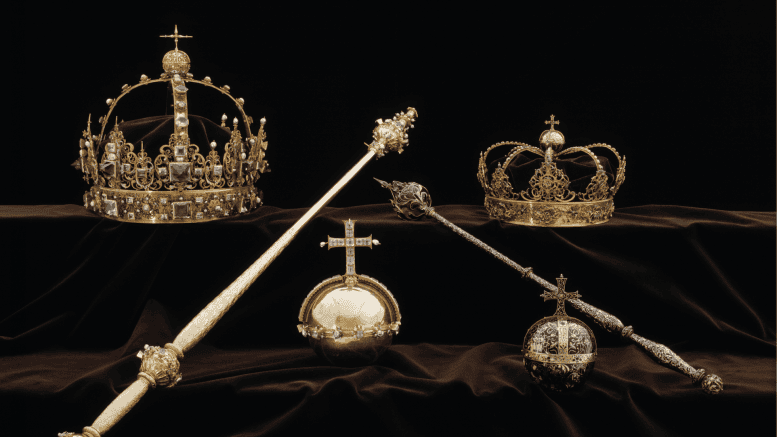
The historic Swedish Regalia is housed in the Royal Treasury under the Royal Palace in Stockholm.
While the jewels have not been worn by the Royal Family since the early 1900s, they are regularly on display during weddings, christenings and funerals. As the Swedish monarch is no longer crowned, the regalia serves in a more ceremonial role for special events.
The oldest objects in the collection are two swords that belonged to Gustav Vasa, the founder of modern Sweden, and the oldest crown on display belonged to King Erik XIV. King Erik’s orb, sceptre and key are also secured in the location.
-

- Crown, orb and sceptre of the King of Sweden. By Jacob Truedson Demitz for Ristesson, Public Domain, Wikimedia Commons
-
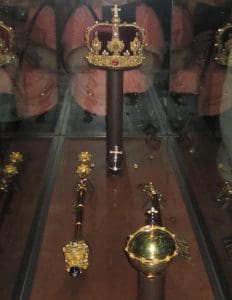
- King Erik’s crown. Photo: Unknown photographer, public domain
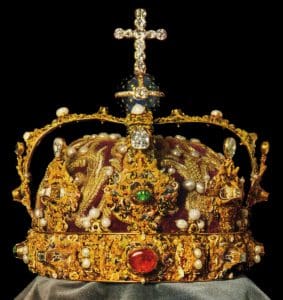
King Erik’s Renaissance-style crown was created in 1561 by Flemish goldsmith Cornelius ver Welden. His gold sceptre was made by Hans Heiderick in 1561 and is still used by monarchs today. The unique golden orb, made by Cornelius ver Weiden, contains an engraved map of the Earth.
Many of the items were damaged over the years and had minor changes to correct the damage done. For example, the sceptre once had a large sapphire on the top, but after it was lost at the baptism of Gustav IV Adolf, the sapphire was replaced with a dark blue enamelled orb.
An anointing horn was made in 1606 by Peter Kilimpe for King Carl IX’s coronation. Made in the shape of a bull’s horn, it has 10 diamonds and 14 rubies.
The Swedish Regalia includes burial regalia, which was stolen in 2018 but later found the following year. It is made up of burial crowns, sceptres and orbs of King Carl IX and Queen Christina. Other burial regalia is on display at various locations, including the Treasury and the Royal Armoury. This includes the burial crown of Queen Louisa Ulrika and the crown of King Eric the Holy.
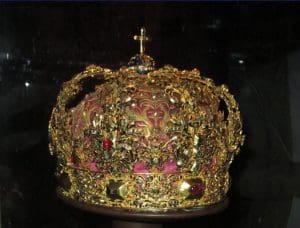
Queen Christina’s Crown. By Jacob Truedson Demitz for Ristesson, Public Domain, Wikimedia Commons
Queen Christina’s Crown was made for her mother in 1620 by German goldsmith Rupprecht Miller with gold, satin and rubies.
The Queen consort also has a crown that dates back to the mid-170os. The red velvet crown has large diamonds that were given to Queen Lovisa Ulrika for her coronation by the Riksdag. The orb and sceptre belonged to Queen Gunilla Bielke.
Included in the regalia is Karl (X) Gustav’s Crown of the Heir Apparent, which was made with a light blue satin cap in 1650 by Jürgen Dargeman. It is now the crown of Crown Princess Victoria, and it was on display during her wedding to Prince Daniel in 2010. It was originally created to be worn by Karl Gustav when he was heir.
There are seven other crowns belonging to Swedish princes and princesses that appear at their christenings and weddings. These include Prince Wilhelm’s crown, Prince Carl’s coronet, Prince Frederik’s crown, Prince Oskar’s crown, and the crowns of Princess Eugenie, Princess Hedvig and Princess Sofia.
The Swedish Regalia can be viewed by the public in the Royal Treasury and has been available for public view since 1970.



Be the first to comment on "The Crown Jewels of Sweden"