
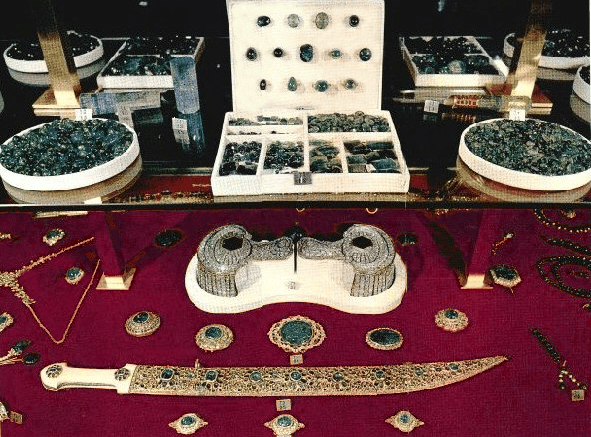
The Iranian National Jewels, once the Crown Jewels of the Persian monarchy, are kept in a vault under the Central Bank of Iran on Tehran’s Ferdowsi Street. The collection includes elaborate crowns, thirty tiaras, a dozen bejewelled swords and shields, and a golden globe with the oceans set in emeralds.
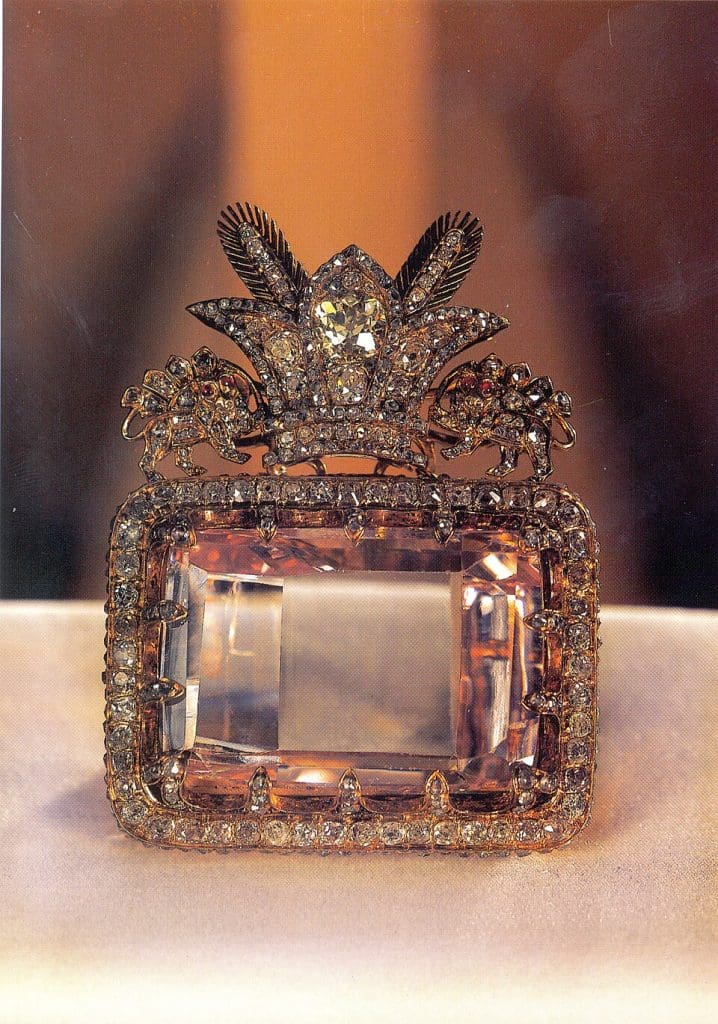
Darya-ye Noor diamond (public domain)
It starts with the Safavids, who ruled Iran from 1502 to 1736 and sent agents abroad just to buy gems for the court at Isfahan. That didn’t last. Afghan forces sacked the city in 1719 and carried much of the treasury off to India. Nader Shah spent nearly a decade fighting to win Iran back, and once he had, he kept going, invading Afghanistan and then India, sacking Delhi in 1739. He came home with rubies, sapphires, emeralds and diamonds, including the Darya-ye Noor, an 182-carat pink diamond thought to be the largest uncut pink diamond in existence. Another stone he brought back, the Koh-i-Noor, didn’t stay in Iran. It later passed to the British Crown Jewels, where it remains today.
Jewellery making revived under the Qajars in the 19th century. Fath-Ali Shah commissioned two of the collection’s most recognisable pieces during his reign: the Sun Throne, later nicknamed the Peacock Throne after his wife Tavus Khanum, whose name means “Lady Peacock,” and the Naderi Throne, a portable chair built in twelve sections and covered in 26,733 gems, including a 225-carat emerald and a 65-carat spinel. Despite the name, it has no connection to Nader Shah.
By the 20th century, the jewels had a second job. Reza Shah moved a large share of the treasury into Bank Melli in the 1930s to back the national currency, a role it still plays. The collection was moved to its current vault in 1955 and placed under the Central Bank once the bank was formally established in 1960.
When the Pahlavi dynasty fell in 1979, there were fears the jewels would disappear in the chaos. A few smaller pieces were smuggled out, but most of the collection stayed put. It went back on public display in 1992 and has remained there since, alongside the Pahlavi and Kiani crowns and a golden globe with the oceans mapped in emeralds.


Be the first to comment on "The Iranian National Jewels"