
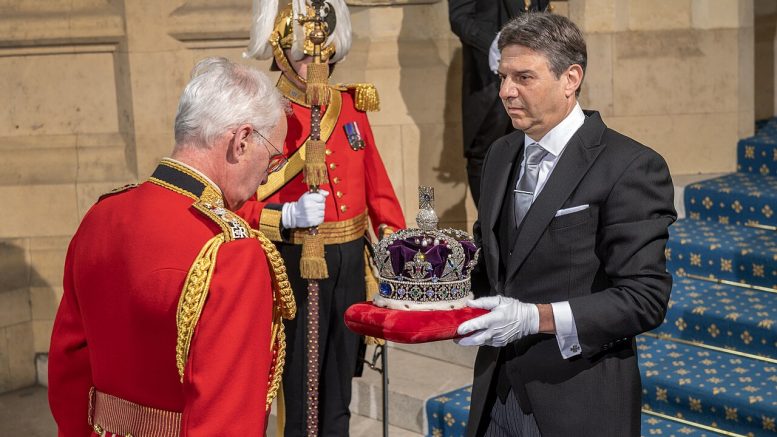
In our continuing series on Crown Jewels, today we look at one of the world’s most magnificent collections —that of the United Kingdom.
Jewellery is a tool royal families use not just for decoration but also for diplomacy. Wearing a certain brooch or tiara could send a message to a host or guest, strengthening ties between countries and families. The United Kingdom’s ‘Crown Jewels’ contain some of the most historic pieces in the world that have found their way to the jewellery vaults of Britain’s royal women.
Today we will venture from deep within the snow of the Romanov imperial courts to pieces acquired or gifted within the decade. Each has its own story, presenting itself as a link between periods of history and familial ties that stretch back centuries.
- What are the Crown Jewels?
The British Crown Jewels are the country’s most precious treasures, comprising over 100 objects and 23,000 gemstones. Some of the most well-known and sacred are the Coronation Regalia, which have been housed and protected at the Tower of London since the 1660s. Their history and provenance draw thousands of visitors each year for a chance to see some of the Crown Jewels on permanent display.
A brief historical background shows that many of the objects held in the collection are fairly recent additions, such as the Imperial State Crown or the Sovereign’s Sceptre. Following the restoration of the monarchy, new jewels were created in 1661 by King Charles II after most of the previous collection was destroyed — Oliver Cromwell, along with Parliament, had the English Crown Jewels melted down in 1649 after the abolition of the monarchy — with a new set needed for his coronation that year.
- St Edward’s Crown
The most sacred and most important Coronation Regalia is St. Edward’s Crown, named after Edward the Confessor. Over 95 years after his death, Edward the Confessor was canonised by Pope Alexander III in 1161; therefore, his possessions turned into holy relics which were then interred with the late King during his burial at Westminster Abbey in 1066. After his canonisation, some of his holy relics (including the crown) were removed from Edward’s remains during his re-interment, when King Henry II built an ornate shrine at the heart of Westminster Abbey. The belief was that the relics should be used in future coronations as opposed to sitting in a tomb,
After the restoration, a new set was made for the Coronation of Charles II. The new set is what we see today.
The current crown was commissioned from the Royal Goldsmith, Robert Vyner, in 1661. While not a replica of the medieval design, it follows the original’s layout, with four crosses-pattée, four fleurs-de-lis, and two arches. It features a solid gold frame set with rubies, amethysts, sapphires, garnets, topazes, and tourmalines. The crown has a velvet cap with an ermine band, per the Royal Collection Trust. It is only used at the moment of crowning during a monarch’s coronation service. The most recent wearer is King Charles III, who was crowned in 2023.
- Imperial State Crown
The second item on our list is most likely one you have seen before, at the State Opening of Parliament or on permanent display at the Tower of London. It is also one of the more recent commissions. The Imperial State Crown was made in 1937 for the Coronation of King George VI and closely resembles a previous crown designed for Queen Victoria in 1838.
While it does not have centuries of canonisations such as its relation, St Edward’s Crown, its prominence comes from its visual appeal; the stones contained within the Imperial Crown hold rich prominence. It was commissioned on 12 May 1937 from the Crown Jewellers, Garrard & Co.
The Black Prince’s Ruby — a large spinel — was traditionally thought to have been the ruby given to Edward, Prince of Wales (1330-76), son of Edward III, and known as the Black Prince, by Don Pedro, King of Castile, after the Battle of Najera near Vittoria in 1367. The 170-carat stone is of Eastern origin. According to the Royal Collection Trust, it passed to Spain in about 1366, when Don Pedro took it from the Moorish King of Granada. In 1415, Henry V wore it in his helmet at the Battle of Agincourt, where a hole was drilled for a feathered plume.
The Stuart Sapphire, St Edward’s Sapphire, Queen Elizabeth I’s earrings — four large pearls of the seven associated with Catherine de Medici who received them from Pope Clement VII on her marriage to Henri II of France in 1533 —, and a stone cut from the Second Star of Africa, Cullinan II, all adorn the Imperial State Crown.
- Sovereign’s Orb
The Sovereign’s Orb is a hollow gold sphere, mounted with a zone and arc set with clusters of emeralds, rubies, and sapphires, surrounded by rose-cut diamonds, each in a champleve enamel mount, between single rows of pearls.
During a coronation, the new sovereign is invested with several ornaments symbolising the chivalric nature of kingship. These include the spurs, swords and armills and then the Sovereign’s Orb, which is placed in the right hand of the monarch, before being placed on the altar. The sovereign also walks out of Westminster Abbey holding the orb at the conclusion of the service.
- Sovereign’s Sceptre
The Sovereign’s Sceptre represents the sovereign’s ‘temporal power’ and is associated with good governance; it was originally made for Charles II. However, the sceptre has undergone several alterations, particularly in 1820 for the coronation of George IV, when an enamelled rose, thistle, and shamrock were added to the monde.
Per the Royal Collection Trust, the sceptre is “formed in three sections, with enamelled collars at the intersections, surmounted by an enamelled heart-shaped structure, which holds a huge drop-shaped diamond, Cullinan I, or the Star of Africa, weighing 530.2 carats. This structure is surmounted by enamelled brackets mounted with step-cut emeralds and a faceted amethyst monde, set with table- and rose-cut diamonds, rubies, spinels, and emeralds, with a cross above set with further diamonds, a table-cut diamond on the front, and an emerald on the reverse. Beneath the Cullinan diamond are further enamelled brackets, representing a crown, mounted with rubies and diamonds. The pommel of the sceptre is enamelled and mounted with rubies, emeralds, sapphires and diamonds.”
- Banqueting and Ceremonial Church Plate
One of the less known items of the Crown Jewels is the Banqueting and Ceremonial Church Plate. The gold tableware was made for Charles II’s coronation banquet. It includes the Salt of State (Exeter Salt), the silver-gilt Plymouth Fountain and Pair of Flagons, a chalice, and a paten.


Be the first to comment on "The Crown Jewels of the United Kingdom"