
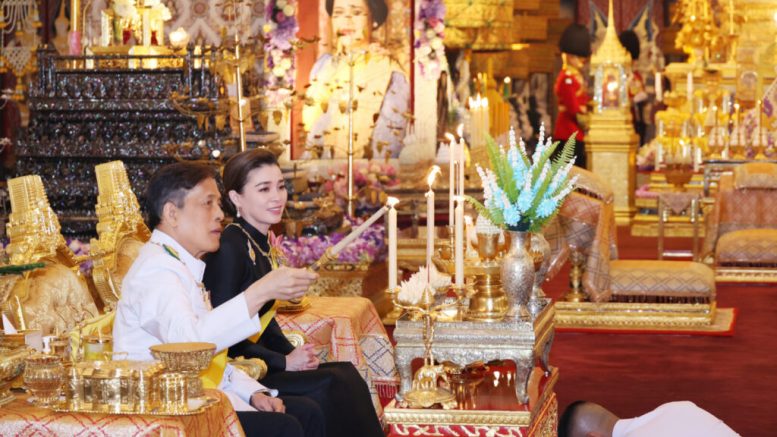
The Royal Cremation of Queen Sirikit, the Queen Mother, is approaching in December; we examine the intricate, centuries-old traditions that will unfold over five days to honour Thailand’s late matriarch.
More than a year has passed since Queen Sirikit died in hospital at the age of 93 on 24 October 2025. Having largely withdrawn from public life since the mid-2010s due to declining health, her passing prompted her son, King Maha Vajiralongkorn, to issue a royal command stipulating that her cremation and all associated funerary rites be conducted with the highest honours in strict accordance with ancient royal tradition.
Over the past year, numerous merit-making ceremonies have taken place while members of the public streamed into the Grand Palace to pay homage before the royal remains, concluding on 22 November. In a historic tribute, King Rama X also granted Queen Sirikit the honour of the Nine-Tiered Great White Umbrella of State (Nopphapadon Maha Sawetachat) above her golden urn. Traditionally reserved exclusively for crowned monarchs, this distinction makes Queen Sirikit the first Queen consort in Thai history to be honoured in this way.
Over the past weeks, central Bangkok has become the focal point of extensive ceremonial preparations. Led by the Royal Thai Army’s First Army Region, thousands of military personnel, palace officials, musicians, and students have been conducting a series of on-site rehearsals around the Grand Palace and Sanam Luang. Following initial practice sessions on 31 October and 15 November, a third major on-site rehearsal took place on 22 November, during which the restored Great Victory Royal Chariot (Phra Maha Phichai Ratcharot) and royal palanquins were brought onto the historic routes. Two final full-dress rehearsals are scheduled for 6 and 12 December to ensure every measured step, musical cue, and chariot transfer is executed with precision.
In December, the nation and the world will bid a final farewell to Queen Sirikit during a five-day ceremonial programme. It will be Thailand’s largest royal funeral since that of her late husband, King Bhumibol Adulyadej, nearly a decade ago. Steeped in a sacred mixture of Animist, Brahman-Hindu, and Buddhist traditions, the proceedings will follow a solemn schedule.
Historically, Thai royal cremations were celebratory affairs; the most senior rites lasted up to fourteen days and nights and featured processions of Buddha relics and public festivities. Modern observances usually span five days, centring on grand funeral processions that convey the royal urn to an elaborate ceremonial pyre—known as the Phra Merumat—modelled on Mount Meru, the sacred centre of the Vedic and Buddhist cosmos.
Schedule of Ceremonies
Day 1 — Tuesday, 15 December 2026
The five-day period commences at 5:00 pm with a royal merit-making ceremony at Dusit Maha Prasat Throne Hall, held in preparation for transferring the Royal Urn to the Royal Crematorium at the Sanam Luang’s ceremonial ground.
- Day 2 — Wednesday, 16 December 2026
The principal cremation rites begin at 7:00 am with a series of grand processions conveying the Royal Urn from the Grand Palace to Sanam Luang:
- The First Procession: Transfers the Royal Urn from Dusit Maha Prasat Throne Hall to the Great Victory Royal Chariot (Phra Maha Phichai Ratcharot) stationed in front of Wat Phra Chetuphon Wimon Mangkhalaram (Wat Pho).
- The Second Procession: A larger formation of 2,746 personnel escorts the Royal Urn over a 1,016-metre route from Wat Pho to the Royal Crematorium at Sanam Luang. Members of the Royal Family — including King Rama X, Queen Suthida, and Princess Sirivannavari — are expected to walk in this main procession.
- The Third Procession: Upon arrival at Sanam Luang, the procession circles the crematorium pavilion three times counter-clockwise over 1,027 metres. This ritual symbolises the Three Marks of Existence in Buddhism: anicca (impermanence), dukkha (suffering), and anatta (non-self and non-attachment).
- Day 3 — Thursday, 17 December 2026
At 8:00 am, a ceremony is held at Sanam Luang to collect the Royal Relics and Royal Ashes. During this rite, the cremated remains (atthi) are placed into smaller golden urns (phra kot phra atthi), while the ashes (sarirangkhan) are gathered into a rounded reliquary vessel (pha-op). Both are subsequently transferred to Phra Si Rattana Chedi at the Temple of the Emerald Buddha (Wat Phra Kaew) within the Grand Palace.
- Day 4 — Friday, 18 December 2026
A royal merit-making ceremony dedicated to the Royal Relics takes place at 5:00 pm inside Dusit Maha Prasat Throne Hall.
- Day 5 — Saturday, 19 December 2026
The final day begins at 10:00 am at Dusit Maha Prasat Throne Hall with an almsgiving ceremony, during which food is offered to Buddhist monks to dedicate merit to the late Queen Mother and express gratitude to the clergy who presided over the rites. Following this service, the Royal Reliquary Urn is enshrined in the Heavenly Abode within Chakri Maha Prasat Throne Hall.
At 5:00 pm on Saturday, King Vajiralongkorn will preside over the concluding act of the funeral: the enshrinement of the Royal Ashes at Wat Ratchabophit Sathitmahasimaram and Wat Bovoranives Vihara—the same two temples that received King Bhumibol’s ashes.<
Broadcast and International Attendance
The National Broadcasting Services of Thailand (NBT) will distribute an international feed with commentary in both Thai and English, while a dedicated press centre at Thammasat University is preparing to host approximately 1,700 Thai and international journalists. Full broadcast and streaming schedules will be released closer to the event (during King Bhumibol’s funeral in October 2017, satellite feeds reached 177 countries).
Questions remain regarding which foreign monarchs and royals will travel to Bangkok to pay their respects. While no official guest list has yet been confirmed, the Royal News Organisation has contacted royal households worldwide and will provide updates as formal confirmations are announced.
December will witness one of the most monumental royal events in modern Thai history, and the Royal News Organisation will provide comprehensive coverage throughout the five days of ceremonies.





Be the first to comment on "Thai royal funerals explained"