
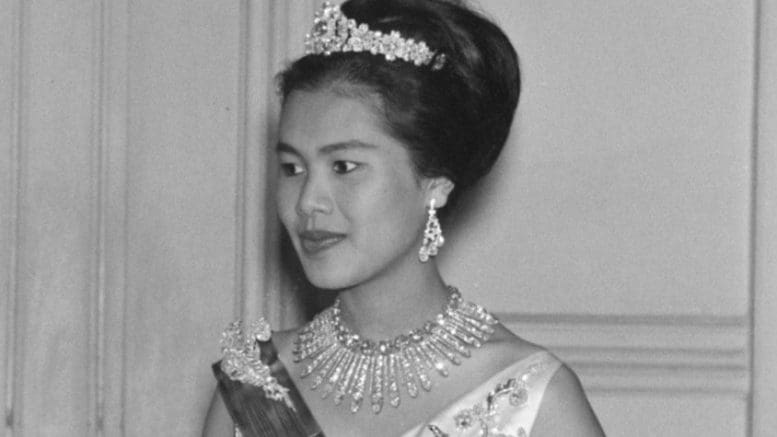
Remembering Queen Sirikit of Thailand shortly after what would have been Her Late Majesty’s 94th birthday.
Thailand celebrated Mother’s Day yesterday — a national public holiday with many across the Kingdom honouring their mothers in special ways. In Thailand, Mother’s Day falls on the anniversary of the birth of Queen Sirikit, the longest-serving Queen Consort in world history, who died last October. It is no coincidence that the occasion coincides with the anniversary, as the cherished late Queen was, and still is, regarded as the ‘Mother of the Nation‘.
The Royal News Organisation looks back at the life of the glamorous, charismatic and photogenic Queen Sirikit as Thailand marks the first Mother’s Day in her absence, bringing so much to so many across the country and abroad. Small annotation: the following article will — with the greatest respect and reverence — refer to King Bhumibol Adulyadej (Rama IX) and Queen Sirikit, the Queen Mother, by their given names for simplicity.
Mom Rajawongse Sirikit Kitiyakara was born on 12 August 1932 as the third child and eldest daughter of Prince Nakkhatra Mangkala, the Prince of Chanthaburi II (then-Prince Nakkhatra Mangala Kitiyakara) in the home of her maternal grandfather in Bangkok. Her name at birth, Sirikit, translates into “the glory of Kitiyakara” (her family name). Both of her parents were descendants of the Chakri Dynasty; she was a great-granddaughter of Rama V. Sirikit’s father was a diplomat, namely the Thai Ambassador to France, while her mother was an actress as well as a royal courtier. Sirikit’s upbringing was comfortable as she navigated the upper echelons of society.
According to History of Royal Women, the title of Mom Rajawongse is “translated as The Honourable and is granted to children of a male carrying the Mom Chao style, meaning Serene Highness. Her grandfather, Kitiyakara Voralaksana, Prince of Chanthaburi I, was the 12th son of King Chulalongkorn, also known as King Rama V.”
Sirikit was raised and educated in Thailand before moving with her family to, amongst other countries, the United Kingdom and France during her father’s diplomatic postings. While in Europe, Sirikit studied English and French as well as classical music; she had wished to one day become a concert pianist.
When her father was serving as Ambassador to France, Sirikit met Bhumibol Adulyadej, who was already King of Thailand and living in Switzerland, at the Thai embassy, where the two studied separately. Bhumibol frequently travelled to Paris during his time in Europe. According to Sirikit herself, during a BBC documentary about the Thai Royal Family in 1980, their first meeting was a case of “hate at first sight”, with the Queen saying, “he said he would arrive at 4 o’clock in the afternoon. He arrived at 7 o’clock, kept me standing there, practising curtsy and curtsy!”
An occasion soon after would show just how devoted the two were to each other — even if just as young teenagers. Bhumibol was involved in an auto accident in October 1948 when he crashed his sports car into the back of a lorry outside Lausanne in Switzerland. The accident cost him his right eye. Sirikit frequently visited the hospital and later recounted how events played out.
He was gravely ill in the hospital. The police rang his mother and The Princess Mother came immediately. Instead of greeting her, he produced my picture out of his pocket, without my knowing that he had one. He said, ‘Send for her, I love her, send for her.
I thought of being with the man I loved only, not of the duties and burdens of [being] Queen. — Queen Sirikit
On Bhumibol’s advice, Sirikit enrolled in a nearby private school and, after getting to really know one another, the two were quietly engaged in Lausanne in 1949 with a formal announcement in London at Sirikit’s 17th birthday festivities, where Bhumibol played solo on the piano as well as accompanied the dance band on saxophone, for which he was well known throughout his life.
On 28 April 1950, the marriage of Sirikit and Bhumibol took place in the Boromarajonani Hall of Sra Pathum Palace in Bangkok. Thailand is today known for the grandeur and intricacies of the Royal Family; however, The New York Times described their wedding ceremony as “the shortest, simplest royal wedding ever held in the land of gilded elephants and white umbrellas.” While Sirikit’s marriage would consequently make her Queen of Thailand, since she was still under 18, her parents had to sign the marriage certificate as well.
The following week, King Bhumibol Adulyadej’s—Rama IX as he was titled, the ninth monarch of the Thai Chakri Dynasty—coronation was elaborate, with a 101-gun salute. A crowned 22-year-old sovereign, the King then invested Sirikit as Queen of Thailand with the title of “Somdet Phra Nang Chao Sirikit Phra Borommarachininat“. The almost shy Sirikit adorned a gold and rose-cut tiara and waved to the crowds which gathered outside the main balcony of the Suddhaisavarya Prasad Hall of the Grand Palace. It would be the start of the longest reigns in world history — Bhumibol is the third longest-reigning monarch in the world — with Sirikit as the world’s longest-serving Queen Consort.
Soon after, Sirikit moved with Bhumibol to Switzerland for continued studies, and it was there in Lausanne where Sirikit gave birth to their first child, a daughter named Princess Ubol Ratana, born in 1951. She would be the only child born outside of Thailand. The small family returned to Thailand in 1952.
Following their return, the young couple garnered much popularity as they began full schedules of engagements. Their second child and only son, Vajiralongkorn, was born in July that year. The King was known for his intellect and work in hydro-management, which was a passion throughout his life — Rama IX created, amongst other inventions, irrigation projects that transformed Thailand. The Queen, on the other hand, realised early on that her wardrobe could send a message by spotlighting Thai silk and the textile industry and craftsmanship that had been in place for centuries but had also been evolving with modern techniques. She gave birth to the couple’s third child and second daughter, Sirindhorn, in April 1955.
In late 1956, King Bhumibol underwent mandatory Buddhist monastic monkhood. During the King’s absence, Queen Sirikit was appointed Regent, albeit very briefly, and stood in for her husband, acting as Head of State on his behalf. Sirikit was sworn in after taking the oath of office at a ceremony within Ananta Samakhom Throne Hall on 20 September. She became the second Queen Regent in Thai history.
The Queen gave birth to the couple’s fourth and final child, their youngest daughter, Chulabhorn, in July 1957.
Queen Sirikit invigorated Thai culture with her choice of dress in Thai silk and traditional textile techniques. She made many visits to rural areas of the country where she took their learned experience overseas into international markets such as Hong Kong and Japan.
“Misunderstandings arise between people in rural areas and the rich, so-called civilized people in Bangkok. People in rural Thailand say they are neglected, and we try to fill that gap by staying with them in remote areas.” — Queen Sirikit
Her devotion led to the preservation of many weaving styles and practices. Sirikit also realised that there was no recognisable style of traditional dress for Thailand that communicated Thai identity. This changed after the Queen, with her close friend and fashion designer Monsieur Pierre Balmain, created eight distinct styles of national dress (known as Chud Thai Phra Rajaniyom) for contemporary and traditional settings. Alongside Monsieur Balmain, the Queen commissioned scholars to research traditional attire of women in the Siamese court, which saw the new styles — Amarin, Boromphiman, Chakraphat, Chakri, Chitralada, Dusit, Ruean Ton, and Siwalai — showcase Thai identity in ways identical to Japan with the kimono, India with the sari and South Korea with the hanbok. Francois Lesage, the iconic French embroidery artisan, was often tasked with the intricate embroidery on the Queen’s wardrobe.
The King and Queen undertook many state visits abroad throughout the 1960s, which saw the world’s eyes fall on the small nation. A glamorous Sirikit and her captivating presence charmed world leaders, from President Dwight D. Eisenhower to President Charles de Gaulle, and she also visited various monarchical countries, which solidified bonds that are just as strong today. The Queen meticulously chose outfits with Thai craftsmanship, as well as adding some Western styles.
During a visit to the United States in 1960, Sirikit and Bhumibol met the King of Rock ‘n’ Roll, Elvis Presley. While American music royalty was meeting actual royalty from Thailand, it was noted that Bhumibol had been a fan of the iconic Presley. The King and Queen also visited Disneyland in California with their children and toured some of the iconic filming locations at Paramount Studios.
It was during these international trips that a dazzling Queen Sirikit captivated the world in a way that would represent Thai women on the world stage. The Queen appeared on one of the most prestigious fashion lists of her time, notably the International Best Dressed List Hall of Fame in 1960, the 1964 list of the world’s best-dressed, Tatler’s Best Dressed List, as well as the 12 Best-Dressed Women Hall of Fame in 1965 in New York. Some even regarded Sirikit as “Asia’s Jackie Kennedy”. She once said to Cindy Adams, “Due to my country’s blessed weather, I have no lines in my face. It is because I perspire so often. This is what keeps my skin smooth.”
In 1976, the Queen founded the Foundation for the Promotion of Supplementary Occupations and Related Techniques, known as the SUPPORT Foundation. According to the Thai Government, “following Her Majesty’s frequent visits to rural areas of the country to obtain first-hand information about local people. Her Majesty travelled throughout the country, accompanying King Rama IX on his various projects to help rural people solve their problems. She noticed farmers’ difficult living conditions and found that their fine craftsmanship in arts and crafts should be preserved for future generations.”
“Her Majesty said that she wanted to see farmers engaged in supplementary occupations to earn more income and spend time fruitfully. Her awareness of the importance of preserving Thai arts and crafts resulted in the establishment of the SUPPORT Foundation under her patronage in 1976.”
“The primary objective of SUPPORT is to form women’s groups and provide them with equipment, materials, and training in cottage industries. With sufficient training, farmers can produce high-quality crafts. Most of the crafts are indigenous to the areas where the projects have been set up and use locally available raw materials.”
The year 1976 also saw a sentimental change in the country’s life; after years of devotion to Sirikit for her years of service, the government designated her birthday as National Mother’s Day, which was previously observed on 10 March. The change of date and public holiday honoured the Queen’s role as “Mother of the Nation” — a title she holds even in death.
Throughout the late 90s and early 2000s Queen Sirikit stayed by Bhumibol’s side as he marked his Golden and Diamond Jubilees as well as his 70th and 80th birthdays. The decades of her husband’s reign were marked by both a succession of political challenges at home and the transformation of Thailand’s image abroad.
However, in 2012 Sirikit suffered a stroke and withdrew from public life. Although the Queen was not in the public eye, she was always in the public consciousness. The Queen’s birthday every year provided the public with an opportunity to see Sirikit through carefully selected photos released by the Palace, often from the hospital.
King Bhumibol Adulyadej (Rama IX) died on the afternoon of 13 October 2016 at Siriraj Hospital after reigning for over 70 years. Sirikit was then elevated to Queen Mother as her son succeeded to the throne as King Rama X upon a grieving nation. Sirikit did not attend any of the elaborate and ornate ceremonies which followed over a period of one year. Bhumibol was cremated in late October 2017.
While the Queen Mother was rarely seen outside of official photographs, her presence in the minds of millions of Thais at home and abroad instilled a love for the monarchy which may have only lasted during her lifetime.
On 24 October 2025, the Bureau of the Royal Household announced the death of Queen Sirikit, the Queen Mother, who died ‘peacefully’ while under care at King Chulalongkorn Hospital in Bangkok. She was 93 years old. Her son, King Maha Vajiralongkorn, announced a one-year royal mourning period with national mourning observed for thirty days. The country grieved the loss of the Mother of the Nation, whose maternal care held much of the country together for the latter half of the 20th century.
In 2026, Thailand celebrated their first Mother’s Day without Sirikit.
Love and kindness is the real thing one should give to [another] person. To give, not to take, only to give. To love. So, that’s the reason my husband and I can work year after year, day after day, without being ill, but we know that when it’s time to die nobody can escape. So it’s better to recontribute as much as we can to society (…). At first I was very afraid of death, but later on I met a great teacher, a monk, who told me to never be afraid of death because it is a natural occurrence.
If you have good intentions towards the other and you have done all you can do for your country and for [fellow] human beings, even if you die, your soul or spirit or mind will be in peace. — Queen Sirikit




Be the first to comment on "Queen Sirikit: Mother of the Nation"