
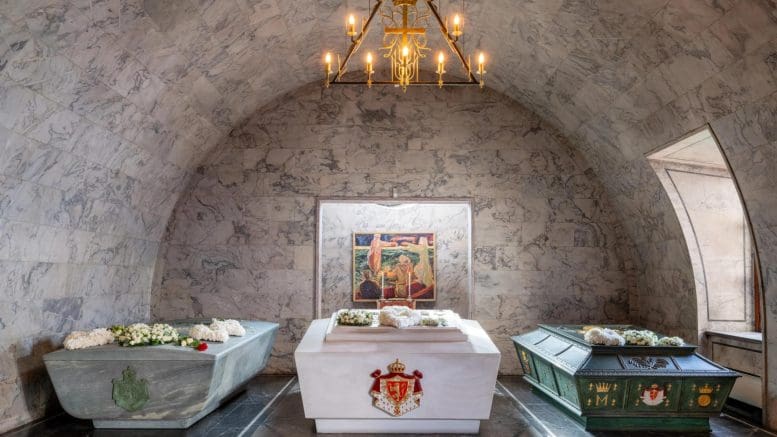
The Norwegian royal court released details on King Harald’s joint sarcophagus, inspired by the late King’s close relationship with the sea, over a week after he was laid to rest.
Details about new joint sarcophagus which King Harald was laid to rest into has finally been revealed by the Palace, nine days after his funeral which attracted the world’s attention. Information about its design, apart from who made it, had been scarce. In 2025, the Norwegian government allocated 20 million kroner for the new sarcophagus with its ultimate ‘unveiling’ to be done after King Harald had passed away.
On Friday afternoon, the Palace released new photos inside the Royal Mausoleum along with complete information about its construction and special materials used at the request of King Harald.
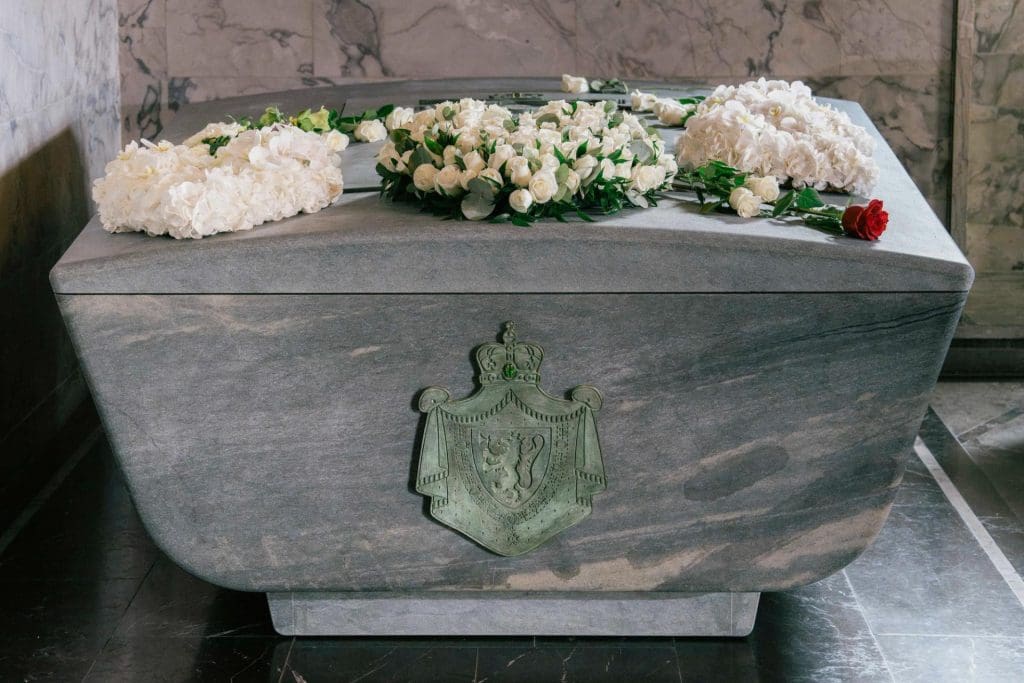
Photo: Ola Vatn, The Royal Court
The new sarcophagus has been designed as a vessel with a rounded bottom that was inspired by King Harald’s close relationship with the sea. The hull is to protect what is on board and carries it safely onward. The motif also draws a line back in history to earlier ship burials, where the ship carried the deceased on a final journey to another realm. The sarcophagus is made of ten stone parts, and all of the sarcophagus’ elements were processed and completed by Johansen Monumenthuggeri in Skjeberg in Østfold, who also installed the sarcophagus in the Royal Mausoleum at Akershus Castle when King Harald was laid to rest.
The material used for the sarcophagus is olivine, a rock formed in the Earth’s interior and pushed forward by the forces that have shaped Norway. Donnas Smykkegalleri in Oslo has contributed with the goldsmithing and filing of letters while Øie & Larsen in Ski contributed to the extraction of the peridots. Norsk Vannskærjen in Sande in Vestfold, was responsible for water cutting of letters in brass.
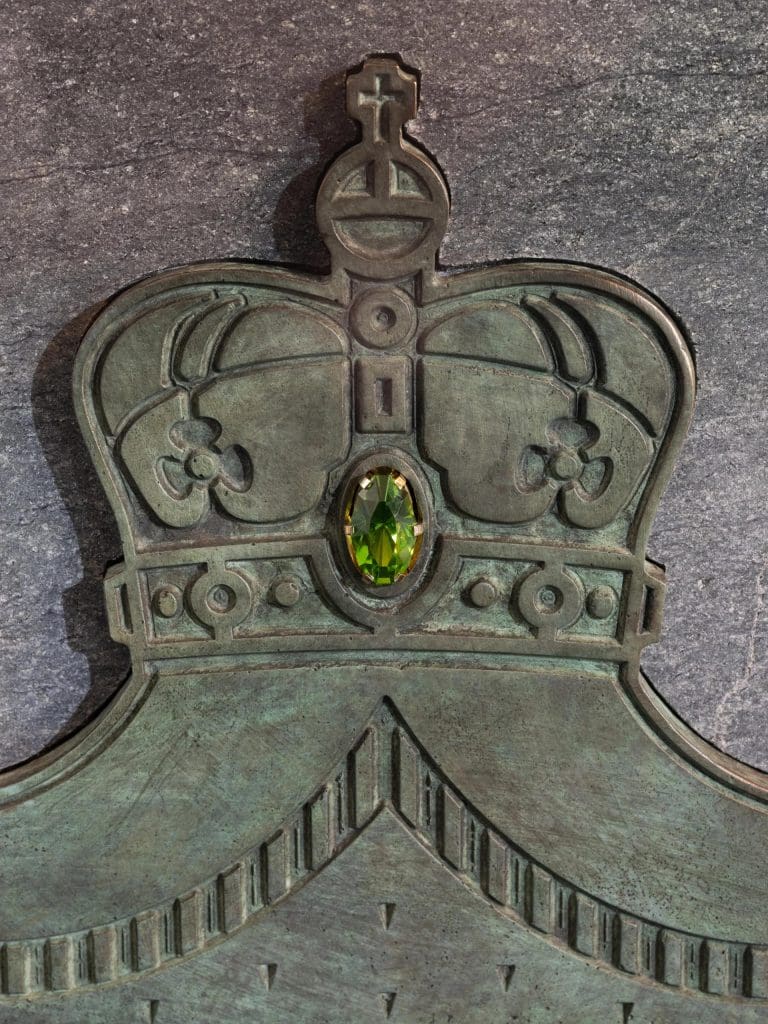
Photo: Øivind Möller Bakken, The Royal Court
The sarcophagus is a joint resting place where Queen Sonja will one day be interred to join her late husband. Just like King Harald’s life at sea, Queen Sonja’s relationship with Norwegian nature has been an important inspiration in the design of the sarcophagus.
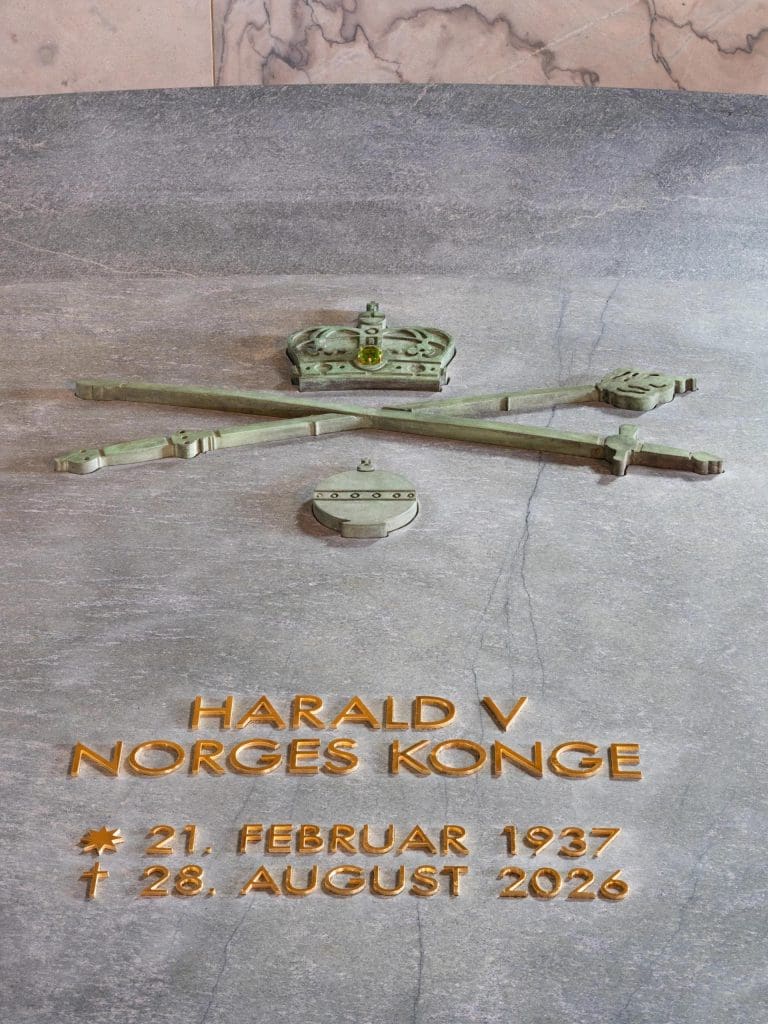
Photo: Øivind Möller Bakken, The Royal Court
Queen Sonja has gone on countless trips in the Norwegian countryside, on foot and on skis all over the country. The Palace notes that it was ‘therefore natural to choose Norwegian stone as the material for the joint Sarcophagus,’ with stone was chosen from Sunnmøre — an area where Queen Sonja has hiked often and knows very well. The greenish olivine stone can absorb and bind CO2, which the designers have emphasised as a symbol of King Harald and Queen Sonja’s love for nature and care for future generations. The joint sarcophagus thus brings together what has been important to each of them into a common resting place.
The sarcophagus is made of Norwegian materials, and designed by the company Snøhetta — led by architect and founder Kjetil Trædal Thorsen — in close collaboration with Norwegian craftsmen and professional communities that uphold long craft traditions.
In the middle of the mausoleum stands a white joint sarcophagus, made of Nordland marble from Fauske, where King Haakon VII and Queen Maud rest. The sarcophagus is adorned with, among other items, the Royal Coat of Arms, Crown and Sword, as well as their respective names and dates.
On the very right of the mausoleum, King Olav V and Crown Princess Märtha rest in a dark green sarcophagus in patinated bronze. After Crown Princess Märtha’s death in 1954, Arneberg was commissioned to design a second sarcophagus, completed in the summer of 1957. King Olav’s coffin was taken from Oslo Cathedral on 30 January 1991, to Akershus Castle for a private service where he was then placed together with Crown Princess Märtha.




Be the first to comment on "King Harald’s final resting place revealed"